50 States of Terror
THE PLOT TO CRIPPLE AMERICA A HIGH-STAKES MILITARY THRILLER BY MARC NEERMAN
What if America’s greatest threat did not come from one massive attack, but from fifty coordinated strikes designed to break the nation’s confidence from within?
In 50 States of Terror, Marc Neerman delivers a tense, action-driven thriller about revenge, intelligence failure, military response, and the quiet courage of those who stand between ordinary citizens and unimaginable danger.
A plot years in the making.
A nation caught in the crosshairs.
A race against time to stop terror before it reaches every state.
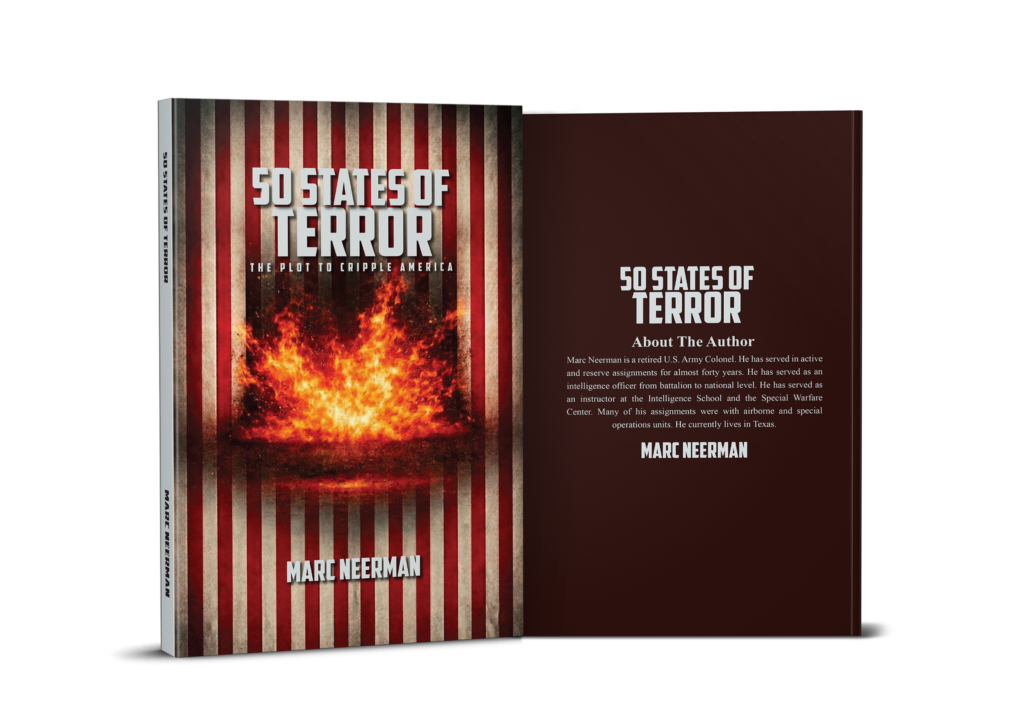
About The Book
50 States of Terror: The Plot to Cripple America is a gripping military and political thriller that begins quietly—with an ordinary-looking man arriving at Mexico City’s Benito Juarez International Airport. He does not draw attention. He does not look dangerous. He moves carefully, avoids leaving a trail, and heads north toward a private meeting that will set the next phase of a devastating plan in motion.
About the Author
Marc Neerman is a retired Army Colonel whose career spans nearly forty years. He has served from Southeast Asia to the Middle East and has worked as an intelligence officer from the battalion level to the national level. Many of his assignments were with airborne and special operations units, giving him firsthand insight into the discipline, structure, and pressure of military and intelligence operations.
Book Trailer
Brief of First Three Chapters
Chapter One — The Arrival
The novel opens with a man who seems completely ordinary. He is not handsome, not tall, not memorable, and not the kind of person anyone would notice on an international flight. He arrives in Mexico City after a long flight from Paris, moving through the airport with discipline and patience. Nothing about him appears unusual, but his thoughts reveal the truth: this trip is the result of months of planning, significant resources, and a mission meant to strike at the heart of America’s confidence.
He rents a Dodge Grand Caravan using false documents and begins driving north. Along the way, he avoids hotels, avoids unnecessary interactions, and remains focused on reaching his contact. His goal is not merely destruction in the physical sense. He wants to damage America’s sense of safety. He wants Americans to doubt their government, their law enforcement, and their ability to live without fear.
By the end of the chapter, the man reaches a walled property near La Ermita, where the next phase of the operation is ready to begin. The chapter establishes the tone of the book: quiet movement, hidden danger, and a threat that is already far closer than anyone realizes.
Chapter Two — Mohammad Abu al-Fadi
Chapter Two introduces Mohammad Abu al-Fadi, the man behind the larger threat. Born and raised in Bandar Abbas, a port city in southern Iran, Mohammad grows up inside his father’s shipping business. As the city expands, the family business grows with it, giving Mohammad access to money, status, and influence. He becomes comfortable around political and religious leaders, not because he is deeply religious, but because he understands the value of being seen among powerful men.
The emotional center of the chapter is Mohammad’s father, Bijan. When the family business purchases a massive new freighter called the Whale, Bijan takes it on its first major voyage. Mohammad is supposed to join him but stays behind after an accident at the docks requires his attention. It is the last time he sees his father alive.
In Muscat, Bijan meets his old friend Ahmed, a wealthy businessman involved in arms smuggling. Ahmed convinces him to transport crates supposedly containing urgent machine parts. Bijan senses something is wrong with the men loading the cargo, but friendship, trust, and routine blind him to the danger. The chapter slowly turns from family history into the setup for tragedy, showing how personal loss, betrayal, and international violence begin to converge.
Chapter Three — The U.S.S. Stephen Casey
Chapter Three shifts to the United States Navy and introduces the U.S.S. Stephen Casey, an Arleigh Burke-class destroyer named after a Navy Corpsman who gave his life saving wounded Marines. The chapter spends time honoring the ship’s namesake, establishing a theme that runs throughout the novel: heroism is often quiet, painful, and paid for in blood.
Commander Joshua Lawrence, the captain of the Casey, knows the story behind his ship’s name and carries that sense of responsibility seriously. The chapter then brings the ship into operational focus near the waters off Yemen, a critical maritime route. As suspicions rise around the Whale, the situation escalates rapidly. A Navy helicopter observes armed men opening crates on deck, weapons appear, and the threat becomes unmistakable.
When men aboard the Whale fire at the helicopter and later at the Casey, the situation turns into a violent confrontation. The chapter introduces the military realism that defines much of the novel: command decisions, rules of engagement, split-second judgment, and the burden carried by officers who must act before a threat becomes catastrophic. It also creates the event that will shape Mohammad’s rage and drive the larger plot forward.
Testimonials
"what Reader are saying"
A thriller that feels frighteningly possible
50 States of Terror pulled me in because it does not begin with explosions or dramatic speeches. It begins with someone ordinary moving through an airport, and that is what makes it so unsettling. Marc Neerman understands how fear works in a thriller: the danger feels worse when it is quiet, organized, and already in motion before anyone knows it exists. The military and intelligence details give the book weight, but the real strength is the sense of national vulnerability. This is the kind of story that makes you keep turning pages because you want to know who will see the pattern first.
Detailed, tense, and written with authority
What I appreciated most about this book is that it feels written by someone who understands the world he is describing. The command rooms, Navy procedures, intelligence briefings, and law enforcement responses all feel grounded. The story does not treat national security like a simple action movie. It shows confusion, competing agencies, legal concerns, bad information, and people trying to make the best decision with incomplete facts. That realism made the suspense stronger for me.
A big-scale story with human moments
This is a large thriller with a national-level threat, but the moments that stayed with me were the human ones. The book pays attention to fathers, families, duty, and the emotional cost of service. Even characters who appear briefly are often given a sense of background and purpose. That made the action feel less mechanical and more personal. It is not just about stopping an attack; it is about the people who carry the burden when everyone else is sleeping safely.
Blogs
Why 50 States of Terror Feels Different from a Typical Thriller
The Power of Realism in Marc Neerman’s Military Thriller
Revenge, Fear, and Duty in 50 States of Terror